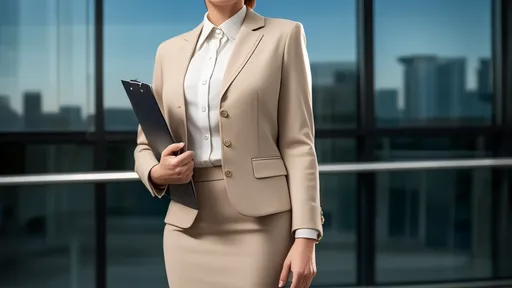
The power suit with its sharp shoulders and tailored lines has long been the uniform of female executives climbing corporate ladders. But in recent years, workplace fashion for women has fractured into competing philosophies - is professional dress code armor against bias, or has it become another subtle form of workplace conformity shaped by male expectations?
Walk through any major city's financial district at 8:45 AM and you'll witness the sartorial schizophrenia of modern working women. Some stride confidently in traditionally masculine-inspired suits, their stiletto heels clicking like metronomes keeping time with Wall Street's heartbeat. Others float by in billowy blouses with statement jewelry that whispers "creative director" rather than "please take me seriously." The variation speaks to an identity crisis with no clear resolution.
The historical context matters here. When women first entered professional spaces en masse in the late 20th century, the directive was clear: blend in. The 1980s power suit wasn't a fashion choice so much as protective coloration in a jungle of male competitors. Shoulder pads approximated male silhouettes; neutral colors avoided distraction; skirt lengths negotiated the impossible tightrope between "prudish" and "provocative." This was survival dressing, not self-expression.
Contemporary workplace attire has theoretically liberated itself from those constraints, but the emancipation feels incomplete. The rise of "business casual" and tech industry informality created new minefields. When Google permits hoodies but Goldman Sachs still demands pantyhose, women must become cultural anthropologists for every new workplace, decoding unwritten rules about bare arms, open-toed shoes, and the acceptability of pattern mixing.
What's particularly insidious is how these choices get politicized regardless of direction. The woman who favors androgynous suits may be praised as "serious" but critiqued as "trying too hard to be one of the boys." Her colleague in floral wrap dresses might be deemed "approachable" yet simultaneously "not leadership material." There's no neutral territory - every fabric choice becomes a Rorschach test for colleagues' unconscious biases.
The male gaze inevitably infiltrates these discussions. When a female CEO's Vogue profile spends three paragraphs describing her wardrobe before mentioning her MBA, we're not in post-sexist territory yet. Studies continue showing that women who wear makeup are perceived as more competent... until they're deemed "distractingly" attractive. High heels still confer authority in many sectors, despite rendering the wearer literally less stable. These aren't fashion choices - they're calculated risk assessments.
Social media has complicated the calculus. Instagram influencers peddle #girlboss aesthetics that merge professional and conventionally feminine signifiers - the pink blazer, the "power ponytail," the stiletto that "means business." The message suggests women can have it all: be taken seriously while remaining unthreateningly pretty. But this hybrid ideal simply piles new expectations atop old ones rather than dismantling the framework.
Perhaps most frustrating is how these conversations remain overwhelmingly focused on women's attire rather than men's. While debates rage about whether a woman's sleeveless dress constitutes "professionalism," her male colleagues skate by wearing decade-old khakis and ill-fitting button-downs without commentary. The asymmetry reveals how much gendered scrutiny women still endure in supposedly egalitarian workplaces.
The solution isn't a return to sartorial puritanism nor wholesale abandonment of professional standards. Some forward-thinking companies have implemented explicit dress codes that apply equally across genders, focusing on practicality rather than propriety. Others have decoupled dress from performance evaluations entirely. But these remain exceptions in a world where a woman's outfit still speaks volumes before she ever opens her mouth.
Ultimately, workplace fashion for women exists in the uncomfortable limbo between self-expression and social compliance. Every morning, millions make silent calculations: How much femininity to display? How much authority to project? Which biases to trigger and which to avoid? Until workplaces evolve to judge women by their output rather than their hemlines, these dilemmas will persist - one uncomfortable shoe choice at a time.
The most radical act may be rejecting the premise entirely. A growing contingent of female professionals wear precisely what they please - whether that means minimalist menswear or riotous prints - and let their accomplishments drown out the commentary. Their numbers remain small but potent. Perhaps true workplace equality will arrive not when women dress "right," but when no one particularly notices what they're wearing at all.

By /Jun 25, 2025
By /Jun 25, 2025
By /Jun 25, 2025
By /Jun 25, 2025

By /Jun 25, 2025

By /Jun 25, 2025
By /Jun 25, 2025
By /Jun 25, 2025

By /Jun 25, 2025
By /Jun 25, 2025
By /Jun 25, 2025
By /Jun 25, 2025
By /Jun 25, 2025

By /Jun 25, 2025

By /Jun 25, 2025
By /Jun 25, 2025
By /Jun 25, 2025
